


SPIELBERG: SHADOWS AND MASKS
- Kevyn Bashore

- Jun 16
- 46 min read
Updated: 8 hours ago
Unveiling Fear, Deception, and the Theology of the Unseen
by Kevyn Bashore
From the shark in the deep below of Jaws to the visitor descending from the sky in Disclosure Day — how one filmmaker taught a generation what to fear, and now teaches it what to welcome, receive, and revere.
A long-form theological-cultural film essay — not a conventional quick review — on cinematic imagination, spiritual formation, and the theology of the unseen.
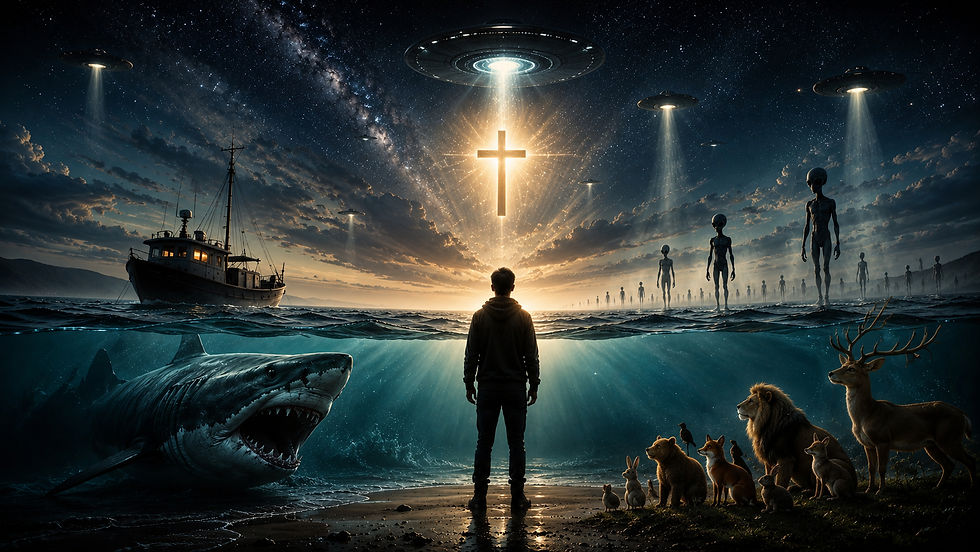
Let me say at the outset: I am a child of the Spielberg generation, and I say it with gratitude. I was called to be a storyteller and filmmaker from the start and I have found Spielberg's films fueling my imagination since I was a teen. I was thirteen years old when Jaws hit the screen. I ducked behind the seat in front of me when the shark emerged from the murky deep — and the severed head lurched from the hole in the sunken boat's hull. I still remember the thrill at nineteen as I once again ducked behind the seat in front of me as the boulder rolled after Indiana Jones — and seemingly upon the audience — in Raiders of the Lost Ark. The Color Purple left me breathless with a story of redemption and a clear vision for the power of cinematography and framing shots, sequences, and transitions. Empire of the Sun gave me one of the most emotionally charged visual turns I have ever witnessed on screen: an apocalyptic flash of light on the horizon — the atom bomb falling on Nagasaki — that the boy takes for a departing soul rising into the sky; Amistad gave me what I still consider one of the most emotionally moving depictions of the Gospel ever filmed — a captive man interpreting the entire story of Christ through the illustrations in a Bible he cannot otherwise read. I count Schindler's List, Jurassic Park, and Saving Private Ryan among the works that taught me what the medium can do with spectacle, entertainment, and excellence in storytelling. So what follows is not the complaint of a man who dislikes Steven Spielberg. It is the unease of one who loves his work — who has felt its power from the inside — and who, for that very reason, takes seriously what such a master chooses to breathe into the world.
You do not measure a thing carefully unless it matters to you.
The Argument in Brief
This is not an argument that Christians must fear every possibility of life beyond earth, nor that cinematic beauty is itself suspect. It is an argument about formation.
Across Jaws, Close Encounters of the Third Kind, E.T. the Extra-Terrestrial, and Disclosure Day, Spielberg’s work repeatedly explores how the unseen is felt: feared, wondered at, befriended, and finally welcomed. Using Scripture and Francis Schaeffer’s standards of art, this essay examines the film’s craft, theology, and emotional architecture — asking not merely whether it is well made, but what it asks its audience to trust, receive, and revere.
Makers breathe something of their inner life into what they create: intention, fear, anxiety, longing, love, conviction, and belief. That breath may reach one person or millions. Its force varies according to the maker’s intention, the work’s craft and beauty, its scale and spectacle, its power to gather attention, and the spiritual weight it carries.
A work does not merely pass before the eyes. It can enter memory, imagination, affection, and belief — shaping what a people fears, what it welcomes, what it trusts, and what it learns to revere.
My contention is that Disclosure Day breathes the imaginative intention of its makers through cinematic wonder: images of revelation, empathy, sacred awe, and nonhuman mediation. It primes its audience to receive unknown beings from beyond the sky without demanding the discernment Scripture requires. In doing so, it risks turning wonder into theological inversion, allowing created beings to occupy imaginative territory that belongs to the Creator alone.
The Two Deeps
There are two deeps that have always frightened the sons and daughters of earth.
The deep below, where the light fails, shadows move beneath the waterline, and fear waits just beyond the edge of sight.
And the deep above, where the night sky keeps watch over woods and mountains, sown with lights and shadows we see, but cannot name.
For more than five decades, a single filmmaker has worked the seam between them both. He began in the physical deep below us with Jaws, where fear performs its own dark baptism, immersing movie audiences in the dread of what they cannot see. Now, in Disclosure Day, he turns our eyes upward to the cosmic deep above, asking us to welcome, to receive, with unguarded hope, whatever shadows may emerge from behind the veil of the sky.
In the trailer for Disclosure Day, and again in the film itself, Spielberg poses the question the whole film is built around: "If someone showed you, proved it to you — that we are not alone — would that frighten you?"
On its face, it is a question about fear. But the deeper question is faith: what happens when the unseen becomes visible, when the mask of mystery is unveiled, and when wonder begins to ask for trust? Will that destabilize your faith?
Which raises the question a careful viewer must ask: whose faith?
And here lies the quiet inversion at the film's foundation. "We walk by faith," Scripture says, "not by sight"; faith itself is "the substance of things hoped for, the evidence of things not seen." But Disclosure Day offers the very opposite of faith — it offers sight. Its cinematic gospel is proof: someone will show you, prove it to you. As entertainment. Or is it? A conviction that no longer rests on the unseen is no longer faith at all. It has become a new way of seeing — and the only question is what it now trains us to see, and to trust.
The danger of Disclosure Day is not that it imagines extraterrestrial life, but that it turns cinematic wonder into theological inversion. It trains the soul to trust the unseen without discernment, and to welcome the creature where only the Creator belongs.
Spielberg does not stage this reckoning in a synagogue, temple, mosque, sangha, or in the declarations of the unbeliever. He stages part of it in a Catholic convent. The anxious believer is Jane, a former novice who left the convent, but not the question of God. Spielberg’s voice of wisdom is Sister Maura, a Catholic sister. The crisis turns on the words of Genesis. Of all the world’s ways of believing, he has chosen to test ours: Christian faith and the Catholic expression of it most specifically of all.
There is something worth pausing over in that choice. Spielberg, who is Jewish, was under no obligation to frame the crisis in Christian terms at all; he could have drawn it through the tradition of his own people, or through none. Instead he reached — as the storytellers of the West reach almost by instinct — for the furniture of the Christian imagination: the dust and breath of Genesis, a Catholic sister and her crucifix, the Two Witnesses of Revelation, and, before the end, the very words Christ prayed in Gethsemane. The apocalyptic grammar of our civilization is Christian to the marrow, and when a master sets out to film the unveiling of a hidden world, that is the grammar he speaks, whether he means to or not. Such a theology cannot be bypassed. It can only be honored or inverted. This film inverts it.
That is his right. A storyteller may set his story wherever he pleases. But in choosing to handle the Christian Scriptures, the Christian God, and the Catholic faithful, he steps onto ground that can be measured — and submits his work to the four tests of discernment such a story invites: accuracy, truth, intention, and honesty.
Schaeffer’s Four Standards of Art
In addition to these four tests, in order to weigh a work like this, I turn to Francis Schaeffer — an evangelical thinker who taught Christians to take art, culture, and worldview seriously. His four standards — technical excellence, validity, intellectual content, and the integration of content and vehicle — help us judge both how well a film is made and what worldview its form carries.
The four tests of discernment named above help us weigh the truthfulness of the story’s claims and implications. Schaeffer’s four standards help us weigh the vessel itself: its craft, integrity, and the bond between what it says and how it says it. Together, they help us discern what a film carries into the imagination and soul of those who receive it.
Disclosure Day is exactly the kind of work that demands this double attention. A Christian viewer must be able to say, without fear, that Spielberg is a master artist — and also ask, without apology, what that mastery is carrying into the soul.
But to weigh this fairly, we must begin further back than the movie, with a more fundamental question: What is Art, this created thing — and does it carry the breath and life of its maker?
What is Art, this created thing — and does it carry the breath and life of its maker?
The Breath of the Maker
“In the beginning …”
Before anything was seen, all that is and ever will be was called into being through intention, word, and breath.
In Genesis, God creates the heavens and the earth — the whole order of the universe — and then forms mankind from the dust of the ground, breathing life into clay and making humanity “in His own image.” From that moment onward, humanity is earth and breath together: dust raised by the life of God, clay bearing His image. We are all shades of clay.
From that moment onward, humanity is earth and breath together: dust raised by the life of God, clay bearing His image. We are all shades of clay.
In Exodus, Bezalel is the first artisan Scripture explicitly describes as filled “with the Spirit of God” for the work of making: wisdom, understanding, knowledge, craftsmanship, design, and sacred work. He is not introduced as a king, prophet, warrior, or priest, but as an artist-craftsman commissioned to make the tabernacle beautiful and holy. Creation begins with the breath of God. Sacred making begins with the Spirit of God.
The history of Art keeps circling this mystery.
In the High Renaissance, Michelangelo imagines the figure sleeping within the marble; the sculptor does not merely invent it, but frees it. The hand that carves obeys the mind that sees what is waiting to be revealed.
John Ruskin sees a made thing as bearing the life of its maker — the freedom, labor, and blessed imperfection of a human soul still breathing through the work.
In The Idiot, Dostoyevsky places before Prince Myshkin the haunting claim, reported by others, that “beauty will save the world.” Yet beauty does not save because it is merely beautiful. It saves only when it leads us beyond itself to the greater Artist — the Creator from whom all true beauty descends.
Tolstoy sees art as the contagion of inward life: one soul’s felt experience passing through image, sound, and story until the artist’s hidden burden, wonder, or fear begins to live within another.
George MacDonald sends the imagination through fairyland not to flee reality, but to awaken to it: wonder becomes a key, opening the heart to the holy country hidden behind the visible world.
Dorothy L. Sayers sees in every act of making an earthly trinity: the idea conceived within, the work embodied in time, and the living power by which it enters another soul — a finite reflection of the Father, the Word, and the Spirit.
Tolkien calls the artist a sub-creator beneath the Maker — a bearer of refracted light, entrusted to shape the colors of creation into living worlds that may lead the imagination toward truth or bend it toward illusion.
Madeleine L’Engle saw true art as incarnational: not propaganda dressed in religious costume, but truth becoming flesh in form, image, sound, and story.
C. S. Lewis, whose imagination he said was “in a certain sense, baptized” after reading George MacDonald’s Phantastes, understood the imagination as a doorway through which the soul may be awakened toward truth, trained to desire the good, and opened to the deeper reality behind the visible world.
But a vessel — even a beautiful and brilliantly made vessel — does not judge what it carries.
Across the centuries, these witnesses describe different facets of the same mystery: the image-bearer making under the Maker; the imagination awakened toward reality; truth taking form; inward life passing from soul to soul. Yet the same principle has a darker edge. If a created work bears something of its maker, it may also carry the maker’s loves, wounds, fears, and distortions into those who receive it. Not every transmission is holy. Not every image heals. Not every act of artistic incarnation gives flesh to truth.
Across the centuries, these witnesses describe different facets of the same mystery: the image-bearer making under the Maker; the imagination awakened toward reality; truth taking form; inward life passing from soul to soul.
Some works carry wonder.
Some carry worship.
Some carry mercy.
And some carry fear.
When the Vessel Carries Fear
By his own account, Steven Spielberg was a frightened child: afraid of small spaces, the tree outside his bedroom window, storm clouds, darkness, and the world that changed shape after sundown. He did not find a way to dissolve those fears. He found a way to move them. He told terrifying stories to his younger sisters. Later, he explained: “This removed the fear from my soul and transferred it right into theirs.”
He did not find a way to dissolve those fears. He found a way to move them. He told terrifying stories to his younger sisters. Later, he explained: “This removed the fear from my soul and transferred it right into theirs.”
That sentence is not speculation. It is confession. It is not a critic prying into the private
chambers of a maker’s heart. It is the maker naming his own method.
Fear, in Spielberg’s hands, is not merely expressed through art. It is relocated through art. The artist does not purify what he holds; he purges himself by pouring it into the work. Jaws becomes the vessel built to industrial scale.
That is not merely metaphor. By the end of Jaws’ first summer, 21 percent of Americans had already seen the film; among adults eighteen to twenty-nine, the number was 40 percent. Of those who watched it, 18 percent called it the most frightening movie they had ever seen, while 35 percent said it increased their fear of swimming in the ocean. Nearly two-thirds believed it was too frightening for children under twelve.
The fear had moved from screen to body, from fiction to water.
Gallup measured the fear of the ocean. But the film’s imaginative afterlife spread farther still. For many viewers, its unseen predator followed them into lakes, rivers, pools, bathtubs, and the dark water beneath a drain. The shark did not need to be physically possible in every body of water. Spielberg had taught the imagination to suspect what could not be seen below the surface.
Spielberg took the project, in part, as an act of imaginative retaliation: the novel had frightened him, and he wanted to strike back at what had frightened him. Then circumstance handed him his method. The mechanical shark kept failing, so the monster could rarely be shown. Terror had to be built instead from everything around the absence: the camera dropped to the waterline where the swimmer cannot see what the audience cannot see either; the deliberate refusal to let land enter the frame, so the viewer would feel the same closing isolation as the men on the boat — nowhere to swim, no shore to reach, no visible escape.
He made the unseen do the work the imagination always does best, which is to supply a horror more visceral, jarring, and emotionally imprinting than any fake shark could manage.
And then it was broadcast. Jaws became the highest-grossing film made to that point and the prototype of the summer blockbuster — a transmission on a scale Hollywood had rarely seen. A boy’s private dread, sublimated into two hours of silver-screen light, was copied into millions of nervous systems worldwide and gripped in suspension there.
People who would never meet a great white shark acquired a fear of one. But the deeper mark was never merely the shark. Across more than five decades, critics, viewers, and Spielberg’s own collaborators have returned to the same recognition: Jaws did not leave a generation afraid only of a predator. It left them afraid of the water, of the unseen, the unknown, the shadow — or evil — that may be lurking just below the line of sight. In the water. On the land. In the sky. Anywhere.
The shark was the occasion. The true cargo was dread of what cannot be seen and cannot be
controlled.
That dread proved immune to every fact a marine biologist or scientist could marshal against it. You cannot reason a person out of a fear that bypasses reason, lodging itself into the infinite recesses of the mind and soul. Jaws did not invent the fear of the deep or of the unseen: it gave that fear a permanent image, a sound, a rhythm, and a conduit through which to enter the world. And into souls.
I know, because it entered mine.
I was a child of that generation, and the fear Spielberg breathed into the dark of the theater
lodged itself into me as I turned thirteen years old and it would not leave. It was never only about a shark. It was the darkness itself — the shadow below my line of vision, the dreaded evil that might rise without warning from beneath my own awareness.
It held me for almost twenty years: fear of oceans, lakes, rivers, streams, creeks, pools,
darkness, shadows, nighttime, the woods, my home, my bedroom, and more. Anything that did not reveal what lay beneath became suspect. And I was not alone. Years later, I stumbled upon a television interview where Spielberg spoke of wanting audiences to feel the fears that had haunted him — through his films. Just as he had transferred his early fears to his sisters, he made a career out of transmitting those fears to the masses through entertainment. Untold numbers have testified to carrying similar illogical fears after viewing Jaws. It became, for many of us, a kind of cultural contagion: an image-borne fear that lodged beneath reason. Thankfully, I was eventually delivered from this, not by argument or reason, but by prayer, by God, by the slow and deliberate pursuit of being set free from a terror that had been breathed into me before I was old enough to refuse it.
That is the power of the maker to breathe something into a work — and the power of the work, as vessel, to carry it onward and outward to the masses. For good — or for ill.
What a maker pours into a work through spirit, intention, fear, longing, or conviction becomes part of the work’s inner life; and when the audience encounters it, that life can enter the imagination, the body, the memory, and the places beneath consent.
What a maker pours into a work through spirit, intention, fear, longing, or conviction becomes part of the work’s inner life; and when the audience encounters it, that life can enter the imagination, the body, the memory, and the places beneath consent.
Which is precisely why it matters, gravely, what a maker chooses to breathe into a work the
whole world will encounter.
Firelight and the Long Persuasion
More than five decades after Jaws, the same maker returns to the same method. Only the cargo has changed.
But that cargo is older than it looks. Spielberg’s first feature, Firelight (1964), made when he was seventeen and shown once in his hometown, was already a feature-length science-fiction story of mysterious lights in the sky and the intelligence behind them that takes people in the night.
Even the phrase close encounters came from Dr. J. Allen Hynek, the astronomer and civilian scientific consultant to the Air Force’s Project Blue Book, who devised the classification system. Hynek later served as a technical adviser on Close Encounters of the Third Kind and appears briefly in the film.
The pattern is simple and staggering: this body of work begins with visitors descending from the sky and now comes full circle with visitors descending from the sky. Firelight was the first frame; Disclosure Day is the present bookend. More than six decades of a recurring vision aimed at the same heavens.
Two years after Jaws, Spielberg made Close Encounters of the Third Kind — and recentered the emotional imagination of alien contact for a new blockbuster generation. Earlier science fiction had its benevolent exceptions, but Hollywood had often framed extraterrestrial arrival through invasion, Cold War anxiety, and menace. Spielberg made the visitor a figure of longing, wonder, and homecoming.
Between that first film and his latest, he taught a civilization how to feel about the sky...
Between that first film and his latest, he taught a civilization how to feel about the sky: an ordinary man drawn up from his kitchen table toward a mountain and a descending light, abandoning wife and children to climb aboard. Five years later came E.T., and the visitor was no longer merely benign but beloved: a creature a child would hide in his closet and weep to lose. Through the decades that followed he kept the theme burning even when he did not direct it — producing the abduction saga Taken, lending his name to Men in Black, Transformers, Falling Skies, Super 8 — pausing only once, in War of the Worlds, to remind us he could still make the Visitors terrifying when he chose. For nearly five decades, through wonder and yearning and the steady repetition of the upturned face, he has been schooling a civilization to long for the very arrival this film now stages. Even CNN, surveying his career beside the new release, put it plainly: "whether he meant to or not," Spielberg has spent more than forty years trying to convince the world that we are not alone.
The difference now is that the longing is no longer offered as a story. Disclosure Day, Spielberg says, is "my first film that will be considered science fiction that I do not consider to be science fiction" — a work "much more reflective of the world as it is." By his own account he has "been a believer since I made Close Encounters fifty years ago." So the wonder he has spent nearly five decades teaching us to feel as fiction, he now asks us to receive as fact. The question that animated Close Encounters — what if they came? — has hardened into a claim: they are here; listen. This is not a first contact. It is the last move in a long persuasion — the frontal assault for which the whole luminous filmography was the patient siege.
The Age of Disclosure
Disclosure Day arrives inside what journalists and Unidentified Anomalous Phenomena (UAP) believers have called an Age of Disclosure — after the 2017 public reporting on the Pentagon's UAP program and the 2023 congressional hearings that brought UAP testimony into the center of American public discourse.
Spielberg has said these developments reawakened a conviction he had long held in check. For decades he refused to "categorically state that life from out there has come here" until he saw it with his own eyes — and he never has. Now, pointing to that reporting and testimony, he calls the circumstantial evidence "overwhelming," and admits "a very strong suspicion that we are not alone here on Earth right now." Whether or not one accepts the broader disclosure narrative is not the focus of this essay. The public facts are already enough: Spielberg believes the question matters. His screenwriter, David Koepp, has said Spielberg viewed this film as the summation of what he had to say on perhaps the single most important subject to him.
So the film must be treated accordingly.
It is not simply spectacle. It is testimony.
And if it is testimony, then the question is not only whether it is beautiful or entertaining. The question is: what does it testify to?
Spielberg's Disclosure Day asks: what becomes of human faith if we learn, beyond all doubt, that we are not alone? It is a fair question to ask. Christian faith need not be threatened by the bare possibility of other creatures in God's universe. If God is God at all, He is God of every star, every world, every creature, every intelligence, visible and invisible.
But a film does not merely ask. It answers — in image, music, structure, sympathy, and climax. It answers in the mouths of the characters we are given to trust. It answers in what the camera reveres. And the answer it breathes into its audience is the thing to watch.
But a film does not merely ask. It answers — in image, music, structure, sympathy, and climax. It answers in the mouths of the characters we are given to trust. It answers in what the camera reveres. And the answer it breathes into its audience is the thing to watch.
Before Judgment: Excellence and Validity
Here Schaeffer's four standards come into play, so let us set them plainly before we use them.
Technical excellence asks whether the filmmaker has mastered the formal means of cinema: image, composition, performance, rhythm, sound, editing, light, suspense, and scale.
Validity asks whether the maker is acting with integrity toward the worldview he is expressing in the work, rather than merely chasing money, fashion, or acceptance.
Intellectual content asks what vision of reality the work communicates — its view of God, man, good, evil, truth, beauty, salvation, and the world.
The integration of content and vehicle asks whether the film’s form actually fits and reinforces the worldview it claims to convey.
The first two — excellence and validity — must be weighed before judgment begins. By the first, technical excellence, Disclosure Day must be honored before it is opposed. Spielberg remains one of cinema's great handlers of wonder, dread, motion, faces, light, and communal attention. Even reviewers who criticize the film’s ideas tend to acknowledge the charge of its set pieces, the fluency of its visual grammar, and the skill with which the camera converts spectacle into shared feeling.
The actors serve that excellence. Emily Blunt grounds Margaret Fairchild in finite human strain rather than superhero invulnerability. Josh O’Connor gives Daniel Kellner’s whistleblowing a moral unease rather than simple bravado. Colin Firth makes Noah Scanlon frightening not because he is monstrous, but because he is polished, managerial, and plausible. Colman Domingo gives Hugo Wakefield the calm authority of a secular prophet. The craft matters, because the craft is what makes the transmission believable.
By Schaeffer’s second standard, validity, the film appears sincere. It does not feel like a mercenary piece of franchise machinery. Spielberg’s public comments show that the question of UAPs and alien disclosure is not a borrowed trend for him. He has said he finds the recent UAP disclosures compelling and long overdue, and that after decades of withholding judgment — refusing to declare that life had come here until he saw it himself — he is now persuaded by what he calls "overwhelming" circumstantial evidence. Screenwriter David Koepp has likewise described an unusually focused process, with Spielberg’s own treatment forming the bones of the story and many rounds of revision shaping the final work.
So the critique cannot honestly be that the film is careless, cheap, or cynical. Schaeffer would
forbid that shortcut. Still, the film’s technical mastery does not exempt it from smaller credibility strains: improbable escapes, conspicuously convenient concealments, fairy-tale animals that feel too openly artificial, and a final alien image the film stages in a register of sacred awe. But the deeper danger is precisely that Disclosure Day is technically skillful and sincerely made. It is not a crude vessel. It is a beautiful one. Therefore the question becomes sharper, not softer: what does this beautiful vessel, made with technical excellence and validity, carry?
The First Test: Accuracy
The hinge is a telephone call. Jane, a former novice who has not stopped circling the question of God, is unsettled by what the coming revelation will do to the world’s belief. Her concern is not merely social panic. It is idolatry. She fears that awe of alien intelligence will dethrone God in the human imagination — that "supreme beings" will replace the Supreme Being. Pressing the point, she reaches for Scripture: Genesis, she says, tells us we are God's "supreme creation." Then comes Sister Maura, written as the film's wise and gentle voice of faith, who answers with equanimity: Genesis says we are God's supreme creation on earth. It describes what God made here, and does not rule out other worlds. Why, she asks, would God make so vast a universe and save it only for us?
Taken at that level, the exchange is not heresy. It is even, in part, true. "Supreme creation" is a fair enough gloss on Genesis 1, where humanity is made last and given dominion, the crown of the earthly order; and Scripture nowhere declares the cosmos empty of every other creature God may have made. The Christian and Jewish traditions have long been able to hold such questions without the collapse of faith. On the plain level of accuracy, then, the film does not crudely misquote Genesis — and a critique that accused it of doing so would itself fail the very test it claims to apply.
The trouble is subtler, and it lives in a single word: supreme.
Within one short scene the film lets that word slide across two different meanings. Of humanity, it means supreme creation — the highest of God’s earthly works, yet still a creature. Of God, Supreme Being names the One to whom worship belongs. Jane fears that the apparent superiority of the Visitors may displace Him; Maura answers by conceding the lesser claim, humanity’s earthly supremacy, in order to leave the heavens open. And in that exchange the question itself is quietly recast: from what humanity is — an image-bearer, breathed full of God's own life — into where humanity ranks — supreme here, perhaps, but liable to be outranked out there.
That recasting is the real sleight of hand, and Scripture refuses its very terms. Our standing before God was never supremacy of any kind — not of intellect, not of power, not of rank in some cosmic ledger to be revised the moment a higher intelligence descends. It was the image of God, and the breath of God, in the dust. A being more advanced than we are would move us on no ladder that matters, because the ladder was never the point. Genesis does not seat us at the top of creation; it binds us to the Creator.
Our standing before God was never supremacy of any kind — not of intellect, not of power, not of rank in some cosmic ledger to be revised the moment a higher intelligence descends. It was the image of God, and the breath of God, in the dust.
Once the question has been framed as a contest of rank, the ground is already lost and the film frames it exactly so, in the mouths of its most sympathetic believers. The words are defensible one at a time. It is the drift between them — from supreme creation to supreme being — that does the quiet work. Whether that drift is the carelessness of a screenplay or the craft of a master who knows precisely how a scene teaches the soul, we will weigh under the test of intention. For now it is enough to mark that the imprecision is not random: every slip leans the same direction, away from the Creator, and toward the creature descending from the sky.
The Second Test: Truth
Accuracy, though, is only the surface. The deeper test is truth — not whether a sentence can be defended in isolation, but where the whole work finally points the soul.
Scripture itself draws this very line. Moses warned Israel that a prophet might arise and "giveth thee a sign or a wonder, and the sign or the wonder come to pass" — and that even then, if he said, "Let us go after other gods," the people were not to follow: "thou shalt not hearken unto the words of that prophet." The wonder might be genuine. The proof might hold. And it would not matter — for a sign is judged not by whether it is real, but by where it points. This is the hinge the whole film turns on and never admits. Disclosure Day's entire claim upon us is proof: they showed you, proved it to you. But proof was never the question. A true wonder that turns the heart toward another god is precisely the wonder Scripture commands us to refuse.
Here Schaeffer’s third standard enters: intellectual content, the worldview that comes through the work. Disclosure Day is not merely suspicious of institutions. It is telling a revelation story. Truth is hidden by elites, sought by the wounded, mediated by chosen witnesses, confirmed by higher Visitors, and received by the world in awe. That structure is religious before it is political.
A woman, witnessing Margaret’s otherworldly abilities, crosses herself and kneels before her. Margaret recoils from the gesture, crying, “I won’t be your religion!” Yet the scene still places alien-linked power within explicitly religious visual grammar: reverence, kneeling, crossing oneself, and the fear that a human mediator may become an object of devotion.
That is the tension in it — and the danger of it.
No one is frightened into this belief.
They are reassured into it.
This is where several favorable Christian readings are useful, because they reveal exactly how
the film wants to be received. These reviewers are not fools. Many see what is good in the film: the Church is not mocked; doubt is not demonized; Sister Maura is not a caricature; faith is presented as spacious enough to encounter mystery. That is not nothing. It may even be one reason the film is so effective.
The strongest deception rarely arrives wearing the face of contempt. It arrives wearing the face of sympathy.
The strongest deception rarely arrives wearing the face of contempt. It arrives wearing the face of sympathy.
The film gives Christians just enough honor to earn their trust. It offers one orthodox sentence — God is God of the whole universe — and then asks them to keep following the camera beyond what that sentence permits: from wonder at creation into a spiritually charged receptivity toward the Visitors and the revelation they bring.
The Third Test: Intention
Which brings the gravest test: intention.
Here we must speak carefully, but not timidly. I am not claiming to know the final condition of Spielberg’s soul, nor every private motive he would name for himself. No human can see that far. But we can judge a work by what it places before the audience, what it asks the audience to trust, what it trains the soul to receive, and what its images surround with spiritual weight.
With Jaws, the intention to transmit fear is not speculation. Spielberg himself gave us the key: he learned as a child that telling a story could remove fear from his own soul and transfer it into another’s. He then became a master of exactly that exchange.
With Disclosure Day, the intention is not the same in emotional tone, but it is similar in structure. Spielberg is again using cinema to transfer an inward reality into the audience: not fear of the deep this time, but a movement beyond fear of other beings in the universe toward trust in disclosure, alien mediation, and the healing promise associated with their arrival.
This, I believe, is what Disclosure Day is built to breathe into a global audience: a quiet re-ranking of creation, in which Visitors from elsewhere are imagined as spiritually higher or nearer to God than the image-bearers He formed from dust and filled with His own breath.
It is a beautiful vessel.
What it carries is a lie.
And the lie is exactly the inversion of Genesis, where nearness to God was never a matter of
capability, intelligence, technology, luminosity, or rank. A more advanced creature, however
radiant, remains a creature still.
For Scripture leaves no rung for it to climb. "By him were all things created," Paul writes, "that are in heaven, and that are in earth, visible and invisible, whether they be thrones, or dominions, or principalities, or powers: all things were created by him, and for him."
Whatever waits behind the veil of the sky — however luminous, however ancient, however far beyond us — was made through Christ and for Christ. A being that owes its very existence to the Creator cannot displace the image-bearers He formed from dust and filled with His own breath, nor claim the reverence that belongs to God alone. Nearness to God was never a function of altitude.
A being that owes its very existence to the Creator cannot displace the image-bearers He formed from dust and filled with His own breath, nor claim the reverence that belongs to God alone.
The Alien Savior
Schaeffer’s wider cultural critique helps name the wound beneath the film. Modern man,
having crossed what Schaeffer called the line of despair, keeps looking for a source of meaning large enough to rescue him after he has cut himself loose from "the God who is there." He may look to politics, psychology, technology, sexuality, revolution, or the cosmos. But the search remains religious even when it refuses religious language.
Disclosure Day is saturated with that despair. The world is near war. Institutions lie.
Corporations hoard truth. Lovers cannot hear one another. Citizens are shielded from reality by those who claim to protect them. Into that exhaustion comes the alien disclosure as revelation, medicine, and salvation.
This is why the film’s worldview is more than curiosity about life beyond earth. The question is not merely, “Could God have made other creatures?” Of course He could. The deeper question is, “What role does the film ask these creatures to play in the human imagination?”
If they arrive as fellow creatures, the Christian has room to wonder. But if the film surrounds them with the roles of healers, mediators, prophets, and bearers of a revelation humanity cannot receive without them, then it has moved beyond curiosity about life elsewhere. It has placed created beings inside imaginative territory that belongs to God alone.
The Fourth Test: Honesty
One test remains: honesty.
To be fair to the work, and to the many faithful readers who have already risen to defend it:
Sister Maura’s one orthodox sentence is genuinely orthodox. If God is God at all, He is God of the whole universe and everything within it. Intelligent life on some other world would be His creatures, no more His rivals than we are. Catholic, Protestant, and Jewish critics have said precisely this, and they are right to say it.
Taken as a line of theology on a page, they are right.
But a film is not a page — and its argument is not carried by its most careful sentence.
Its argument is carried by its images, its music, its climax, and by what the camera frames with reverent attention.
The favorable religious reading is not foolish. It is incomplete. It quotes Sister Maura and too often stops there, skirting past the rest of what the film releases into the air: the Visitors treated as higher beings; the woman who crosses herself and kneels before Margaret — and Margaret’s immediate refusal to become anyone’s religion; the human messengers endowed with powers that draw reverence from strangers; the final revelation staged as if salvation now descends from elsewhere.
The orthodox sentence is real. But it can also function as a permission slip — the reassurance that lets the audience lower its guard while the deeper current of the film carries it toward a spiritually unguarded receptivity that sentence never authorized. A defense resting on one safe line while overlooking the work’s religious imagery and emotional architecture is the very defense the film’s structure invites.
To be precise: the film does not plainly command its audience to worship extraterrestrial beings. Indeed, when one character kneels before Margaret in a gesture of religious awe, Margaret rejects the role. But that corrective moment does not erase the film’s larger visual and emotional pattern. It still surrounds alien-linked power with revelation, reverence, healing, chosen mediation, and a final command to listen. The question is not whether the screenplay issues a literal altar call to the Visitors. The question is whether its images train the imagination toward an unguarded spiritual receptivity that Scripture commands believers first to test.
The Hansel and Gretel House
Beneath even this lies something the film’s beauty is built to keep us from seeing. Strip away the Spielbergian glow, the swelling score, the faces lifted in wonder, the immaculate light falling like benediction, and look plainly at what the story asks us to receive as a gift.
Two children are taken.
Lured.
Abducted.
To keep their minds from breaking, the Visitors come to them disguised — not as themselves, but as a Disney-esque red cardinal, a deer, a raccoon, a fox, the gentle creatures of a child’s picture book — and lead them into a place the film calls the “Hansel and Gretel house.” Yet the image invokes the old gingerbread-house warning: what appears sweet, beautiful, and inviting may conceal the devourer within. There the children are altered: their minds rewired, their natures remade, one toward pure logic and the other toward pure receptivity and feeling. And the purpose is not simply the children’s good, but the Visitors’ design. The two are engineered, from boyhood and girlhood, to become the messengers through whom the whole earth will at last be brought to accept them. Is this truly innocent? An honor? Or are they being used as a Trojan Horse? The film never pauses over that possibility.
A Stranger puts on a friendly face to win a child's trust, takes the child, changes the child, and returns the child — outwardly whole, inwardly rewired — looking out through the same eyes, but with someone else now waiting behind them: a vessel that will one day open its mouth and speak a word to enlighten the world. Or is it deceit? The film favors the former — without any concern for the latter.
Scripture has a name for a power that robes itself in light to deceive: "for Satan himself is transformed into an angel of light." It is no marvel, the apostle says — it is his oldest mask.
Shadows and masks.
The mask that must be unveiled.
But the film has another name for it:
Benevolence.
A fairy tale usually warns the child that sweetness may hide a devourer. Spielberg reverses the warning: the Gingerbread House becomes not a trap to resist, but a doorway to trust. And the film reframes abduction as a sacred “calling” — transforming what might otherwise be read as trauma, violation, and fear into the chosen path of two children marked from the beginning to serve the Visitors and herald their entrance onto the world stage.
And the irony runs straight back through Spielberg’s own hands. When Spielberg made Close Encounters of the Third Kind, he modeled its French scientist, Lacombe, in part on UFO researcher Jacques Vallée. In Passport to Magonia, Vallée placed modern contact accounts beside older folklore about fairies, elves, and otherworldly beings, tracing recurring patterns: luminous visitors, strange journeys, missing time, people taken and returned, altered witnesses, and encounters clothed in the symbolic language of their age.
Vallée did not claim to know with certainty what stood behind these reports. But he argued that the phenomenon could not be reduced to the simple picture of benevolent travelers from another planet. Its masks seemed to change with the culture receiving them.
That is where the irony sharpens. What Vallée treated as an unsettling pattern of shifting forms, Spielberg transformed into a beautiful welcome. Yet the old question remains: when the mask changes, is it revealing truth — or merely making the same deception easier for each generation to receive?
Yet the old question remains: when the mask changes, is it revealing truth — or merely making the same deception easier for each generation to receive?
The folkloric pattern Vallée traced is the very one Spielberg has filmed. He has only changed its moral from beware to believe.
This is why the film’s softness is not an answer to the critique. It is part of the critique. The
terror is not that the Visitors look monstrous. The terror is that they do not. They come as
wonder. They come as childhood animals. They come as healing. They come as light.
Shadows and Masks
Schaeffer’s fourth standard — the integration of content and vehicle — is where the film
becomes most spiritually disturbing. The script says benevolence. The cinematic vehicle often says: possession.
Margaret suddenly speaks languages she has not learned, makes alien sounds, knows what she should not be able to know, and is remade into a human receiver for a nonhuman message. Jane is violated by technology that enters her mind and alters her eye color and self-will. Daniel and Margaret are marked from childhood by beings who approach them through disguises, alter them, and return them to the world as instruments of disclosure.
A Christian critic need not declare that every alien image in the film is literally demonic in
order to notice the category confusion. The film uses images and actions that have long
belonged to the grammar of spiritual invasion: involuntary speech, psychic intrusion, loss of
ordinary agency, eyes changing color, hidden intelligences entering the mind, a body made into a mouthpiece, and then asks the audience to receive that invasion as gift.
That is not harmony between content and vehicle. It is dissonance. The message tells us to trust the Visitors; the vehicle teaches us to recognize violation. The film calls it evolution, empathy, disclosure, and benevolence — yet the form keeps whispering another word: possession. And in one sequence it stops whispering and speaks aloud.
The Subversion of Gethsemane
Nowhere is the insidious nature of this cosmic worldview more glaring — or more devastatingly intimate and spiritually perverse — than in the sequence where Noah Scanlon, as an astrally projected agent, uses power derived from the Visitors to track her, locate her, appear before her — and invade Jane’s mind and body, compelling her toward violence against Daniel. This is no longer an abstract corporate threat. It is an assault upon conscience itself.
Scanlon preys upon Jane's piety, turning the deepest language of her Catholic faith into an instrument of abuse and assault of body, soul, and spirit. As she clutches her crucifix until its sharp edges pierce her palm and draw blood, the scene takes on the wounded imagery of the Passion. What began as a science-fiction thriller becomes an inverted liturgy of coercion.
What began as a science-fiction thriller becomes an inverted liturgy of coercion.
Scanlon assumes the posture of an Anti-Father. He enters the house of Jane's physical presence, then seductively invades the room of her personhood without consent, bends her will, and seeks to turn her body into a weapon against the man she loves — the man he intends to destroy. He does not offer the free, self-giving love of the holy Father. He offers control. Destruction. He speaks into her mind as a puppeteer speaks through his puppet, using stolen power to construct a counterfeit passion play.
Then he reaches for the words of Christ in Gethsemane. He begins the prayer of the Son prior to facing the cross, and presses Jane to complete its surrender: “Nevertheless not my will, but thine, be done.”
But Christ’s prayer was freely offered to the Father in the hour before His sacrifice. Jane’s words arise under psychic invasion, manipulation, and coercion. The holy Father is replaced by the Anti-Father. The language of obedience is made to serve violation. The prayer of the Son’s free surrender becomes a tool for breaking a woman’s will.
This is not homage. It is inversion.
And the inversion exposes a deeper double standard in the film’s moral universe. We are meant to recoil from Scanlon’s use of alien power because it is visibly cruel, controlling, and violating. Yet the film asks us to receive the Visitors’ own interventions — abducted children, altered minds, psychic intrusion, bodies remade for a message — as benevolent awakening.
The difference, the film implies, is not the nature of the power, but who is permitted to wield it. Human tyranny is monstrous; cosmic intrusion is grace. But the visual and moral grammar remains the same: a lesser power enters without consent, alters human agency, and claims the right to direct a human life toward its own design.
That is the profound artistic cheat. The film asks us to fear the human puppet master while receiving the cosmic one as benevolent and worthy of trust. It rewrites assault on human autonomy as beautiful revelation, blinding the viewer to the one thing that has not changed: a creature can be deceived or deceptive, whether it wears a suit or a haloed mask.
This may be the most revealing scene in the entire film.
It reveals the cost of seeking transcendence apart from the Creator. When a human person becomes sacred chiefly because a higher creature can speak through her, the image of God has not been honored. It has been commandeered. Invaded. Possessed. Violated.
The Hollowed Apocalypse
Disclosure Day reaches, too, for the architecture of Christian apocalypse.
Here are Two Witnesses, marked from childhood, set apart, given powers not their own, who
will stand before the world and unveil the revelation that changes everything. That is the very
shape of Revelation’s Two Witnesses who herald the close of the Age — and the beginning of the next.
But the film severs the image from the root that gave it life.
The testimony of the Two Witnesses in the book of Revelation is to Christ. The revelation they announce is His coming in judgment and glory.
Spielberg keeps the shape and hollows it: the marked messengers, the world-altering disclosure, the awe before a coming presence — and into the hollow pours not the Second Coming of Christ, but the revelatory coming of the Grays.
It is the oldest substitution there is: the form of revelation preserved, while its God is exchanged for the higher power of alien Visitors — or whatever finally stands behind them.
And the inversion runs deeper than a swapped revelation. Revelation's two witnesses testify to Christ and are killed for that testimony, left dead in the street until God raises them by His own breath. The film's two are not martyrs but products — engineered from childhood by the very powers they are sent to herald, made into witnesses by the ones they testify for. The true witnesses die for the God they honor. These were manufactured by the beings they are compelled to serve.
And here the film's own logic springs a leak its beauty cannot quite caulk.
If the Visitors can enter a human mind, override a human will, and remake a human being from childhood — as the film plainly shows — then why spend that power on only two? Why engineer a boy and a girl, wait the long years of their growing, and at last unleash them as messengers to plead the Visitors' case, when the same power could have been laid upon the whole earth in an afternoon? Why would beings advanced enough to rewire a soul need advocates at all — need anyone to speak for their silent voices, to shield them, to win them welcome among the very humans they can already command?
It is not a foolish question. It is the seam where the film's theology tears. The story asks the Visitors to be two things that cannot both be true: omnipotent and endangered, god-like and voiceless, able to seize a will yet somehow dependent on goodwill. A sovereign power needs no spokesman. It does not campaign for acceptance; it simply is, and creation answers.
But there is one kind of power that behaves exactly as these Visitors behave — that must work through chosen vessels, must persuade where it cannot command, must win by seduction the consent it has no right to claim. Scripture named it long ago. The deceiver cannot compel worship; he can only solicit it. He cannot mount the throne; he can only counterfeit it, and coax the creature to bow. That the Visitors must groom advocates and court belief is no proof of their divinity. It is the tell of their lack — the unmistakable signature of a power reaching for a reverence it was never owed.
The Final Command
The ending makes the argument plain.
After the files are released and the world sees the Visitors, an alien message is decoded. Daniel whispers the message to Margaret. Then Spielberg’s camera comes in tight, so tight that Margaret seems to address not only the fictional world watching within the story, but the actual audience sitting in the dark.
She says one word.
"Listen."
That is not a neutral ending. It is not merely ambiguity. It is a command.
And the command comes after the unveiling. The world has seen. The creature has appeared. The Visitor is unveiled.
The message has been given. The human mediator now turns toward us, and the film’s final act is to make the audience receptive.
"Listen."
But to whom?
To what?
To the God who breathed life into dust? Or to the new voice arriving from the sky through two previously abducted children, carried by beautiful images, protected by sympathetic believers, and framed as the revelation that may save humanity from itself?
That is the film’s final charge — its counterfeit anointing, its commission to the imagination. And it is not a small one.
Scripture does not command the faithful to listen to every voice that arrives from beyond the visible world. It commands us to "test the spirits."
And the test it gives is not vague. "Hereby know ye the Spirit of God," John writes: "every spirit that confesseth that Jesus Christ is come in the flesh is of God; and every spirit that confesseth not that Jesus Christ is come in the flesh is not of God." The measure of any spirit — any voice, any visitor — is Christ. Not its brilliance. Not its knowledge. Not how far it has traveled, nor how gently it appears. Does it confess Him? The Visitors of Disclosure Day are called higher, wiser, nearer to God — and yet in all their luminous descending they never once name the Name. A revelation that arrives without Christ, however radiant, has already failed the only test the apostle gave. The film says Listen. Scripture says: discern first.
And Scripture does more than counsel discernment; it forewarns of precisely this hour. Paul writes of one whose coming is "after the working of Satan with all power and signs and lying wonders," and of a world handed over — "because they received not the love of the truth" — to "strong delusion, that they should believe a lie." Mark the vocabulary, for it is the film's own: not force but wonders; not argument but signs; not a lie believed against the evidence, but a lie made beautiful enough to be received as truth. That is the pattern Disclosure Day eerily echoes: power, signs, wonders, and a world schooled to long for the revelation before it descends. The film does not merely tell a story about belief. It rehearses the very posture Paul said would one day be asked of a watching world: to behold the wonder, and believe.
The film does not merely tell a story about belief. It rehearses the very posture Paul said would one day be asked of a watching world: to behold the wonder, and believe.
A Personal Witness
Here I must turn personal again.
Watching Disclosure Day, I felt a physical nausea — not the turn of a bad meal, but the body's answer to something my spirit had already discerned. Everything this essay has argued was, in that darkened room, made flesh. I could feel the maker's breathed intention, the inward life poured into the vessel, animating the film from within like a pulse.
I had felt this before.
My spirit recoiled. And my body followed it down.
The same unseen dread that Jaws pressed into me as a child, and held for twenty years, was here again. Only now it was not hunting beneath the water. It was pulsing from the light of the screen, reaching toward me in the language of wonder. And there I sat. Sickened in body and spirit.
Spielberg was doing what he has always done: breathing an intended reality into people who do not know what is entering their imagination, their psyche, their soul. Sometimes for good. Sometimes not.
I cannot know what others perceived. I only know that, sitting in that theater, I deliberately shut the door of my body, mind, and soul against what seemed to press from the screen — and I was kept. I will not give this film another twenty years of my imagination. I watched guardedly because I have learned that wisdom sometimes means refusing an invitation before it becomes an entrance.
A More Difficult Witness
What follows will be the most controversial part of this essay, and I offer it carefully.
I am not writing about fear of the unseen only as an outsider examining a film. I have lived with experiences that, to me, have made the question of spiritual discernment deeply personal.
Since childhood, I have awakened in states of terror and paralysis. I did not experience them as ordinary nightmares from which I awoke, but as encounters I awoke into: vivid images, threatening presences, and a fear so total that I could not simply reason my way free of it. The forms varied — shadows by the bed, animals crawling over me, figures standing in the room, a presence advancing with malice — but the response was often the same: paralysis, dread, and the desperate need to call on the name of Jesus Christ.
I do not ask every reader to explain these moments as I do. Some will call them sleep phenomena, psychological distress, or hallucination. I can only say what they were like from within, and what I found in them: when I called on Christ, the terror broke. The name of Jesus became not an abstraction, but refuge.
In one episode, I heard what I experienced as a voice say, “Give up. Give in. And we will take care of you.” I cannot prove to another person what stood behind those words. But I knew immediately what they asked of me: surrender — not to God, but away from Him. I rejected it.
In such moments, I learned that discernment is a true gift. The soul must know what it will receive, what it will refuse, and to whom it will open its door.
In such moments, I learned that discernment is a true gift. The soul must know what it will receive, what it will refuse, and to whom it will open its door.
That history does not make me an authority over every unexplained experience. It does, however, make me cautious when a film asks audiences to interpret abduction, altered minds, invasive presences, and nonhuman voices as automatically benevolent. I cannot receive such images innocently. Whatever one concludes about their ultimate source, the moral question remains: why should coercion, violation, and the remaking of human persons be baptized as revelation?
That is why Disclosure Day troubles me so deeply. It takes beings who arrive in the night, hide behind disguises, alter children, and enter human minds — then leads the audience toward trust, sympathy, acceptance, and a posture of spiritual openness toward the Visitors, inviting viewers to open themselves, body, mind, and spirit, to them. The film asks us to call benevolent what its own images repeatedly frame in the language of intrusion.
When Entertainment Becomes Formation
That open door is how entertainment becomes formation. A film is never merely entertainment when it teaches the soul what to love, fear, excuse, and welcome. It does not need to preach in order to disciple; it can catechize through beauty — training the imagination through music, framing, sympathy, suspense, fear, and awe, and carrying a worldview into the heart before the mind has finished examining it. We may think we are only watching a story, when in fact we are being invited into a posture: a way of seeing, feeling, trusting, receiving, and acting.
A film is never merely entertainment when it teaches the soul what to love, fear, excuse, and welcome.
Media scholars call this cultivation: the slow, repeated shaping of what a people comes to accept as real, normal, and good through images and stories. A film the whole world watches does not merely depict acceptance of the Visitors; it rehearses its audience in a posture of receptivity, scene by scene, until awe, sympathy, and spiritual openness begin to feel like the natural response. And so its deepest instruction is not simply that humanity is not alone. It is that when the unseen arrives, the faithful posture is surrender rather than discernment, wonder rather than testing, welcome rather than watchfulness.
And it arrives at a curious hour.
The culture is already being catechized by disclosure language: government hearings, testimony, leaked videos, official uncertainty, podcasts, documentaries, and, in June 2026, a Catholic priest removed from his role as an exorcist after publicly warning that some UFO phenomena may be demonic — and now one of the most beloved filmmakers in the world turning that expectation into sacramental spectacle.
Again, one need not claim conspiracy to ask the necessary question. The timing alone is enough to make a Christian critic watchful.
Why this story? Why now?
How can any maker — even one of the most gifted filmmakers who has ever lived — be so sure that whatever is not human must therefore be friendly and mean us only good?
How can a film so aware of human fear be so trusting of nonhuman light?
And how can a Christian viewer fail to remember that Scripture warns not only of darkness, but of false light?
The Creature and the Creator
For more than five decades, Spielberg has taught us how to feel about the unseen. Once he held us beneath the waterline and made us dread what might rise; now he lifts our faces to the sky and bids us long for what might descend. The shark compelled us out of the water. The Visitor wants in — past the eye, past the guard, into the inner room where reverence and allegiance are decided. The direction has reversed, but the hand on our fear is the same hand; only now it does not warn us away from the deep, it beckons us toward it, and asks us to call the descending shadow light.
Yet when navigating such deeps, a reliable compass matters.
Genesis establishes the ground. Spielberg shifts the cultural imagination. Scripture and Schaeffer give us the tests and standards needed to discern what we are seeing, feeling, and being asked to receive. Jaws proves the power of cinematic transmission: how skillfully a filmmaker can breathe dread of the unseen into the imagination of the world. Disclosure Day reveals something even more spiritually consequential — and far more dangerous.
It shows what happens when fear of the unseen is not redeemed by truth, but bent into wonder; when wonder is allowed to drift toward religious reverence; when discernment gives way to surrender; when created beings, however luminous in appearance, are allowed to stand where only the Creator belongs.
The shadows may indeed be unveiled in Disclosure Day. But the light this film offers is not necessarily dawn. It may be a counterfeit morning — bright enough to dazzle, beautiful enough to disarm, and dangerous enough to blind us to the true Light who actually hung the stars in the sky.
For this is not the first work to lift our faces and bid us look up. In the wilderness, when the people were dying of the serpent's bite, God told Moses to forge a serpent and raise it on a pole, "and it shall come to pass, that every one that is bitten, when he looketh upon it, shall live." Healing came to those who lifted their eyes — but to the thing God had appointed, and to no other. And Christ took that ancient image for His own: "As Moses lifted up the serpent in the wilderness, even so must the Son of man be lifted up." There is a looking up that saves and a looking up that destroys, and they are told apart not by the wonder in the sky but by who hangs at the center of our gaze. Disclosure Day lifts our eyes and whispers Listen. The Gospel lifts our eyes and shows us a Man upon a cross. One bids us receive the descending stranger. The other bids us behold the Lord who descended once already — not in a saucer's cold light, but in flesh, down to the very dust He had breathed His own life into — and who was lifted up to draw all men unto Himself.
And this is the charge that falls upon every maker, not upon Spielberg alone. If a work of art is a vessel, and the maker’s breath is what fills it, then every maker bears responsibility for what that vessel carries into the world.
A small work may enter one room, touch one heart, or alter one life. A great work, carried by beauty, craft, spectacle, entertainment, and cultural reach, may travel through a generation. It can enter memory and imagination, shape fears and desires, weaken discernment or awaken it, and leave an imprint long after the final image has faded from the screen.
For whatever we breathe into the things we make, we breathe in turn into those who receive them: into the imagination, the memory, the affections, and the soul; into the very sons and daughters of the earth — men and women made in the image of God. We do not merely entertain them.
We deposit something in them: truth or a lie, light or shadow, courage or fear. And what is deposited may remain.
To make is to be entrusted. Every maker will one day give account not only of what they crafted, but of what they breathed into it — and of what, through it, they breathed into the living souls who received it.
Every maker will one day give account not only of what they crafted, but of what they breathed into it — and of what, through it, they breathed into the living souls who received it.
We can name a shadow; we cannot dispel it. That belongs to God alone — and so the watchman's last word is not warning, but prayer:
Today, may the Shadows and Masks before us — in the world and on the silver screen — be unveiled.
And may the Truth — Christ Himself — be revealed.
In Nomine Jesu
Jesu Juva
Soli Deo Gloria
Note: If this essay has stirred you, please comment below and leave a rating. Your response helps me understand what is being read, remembered, and making a positive impact.

About the Author
Kevyn Bashore is a writer, filmmaker, composer, and story consultant whose work explores faith, fear, beauty, imagination, and the moral weight of stories. His films, music, photography, and essays seek to examine the unseen currents beneath culture and to call the imagination back toward truth, courage, and Christ.
He is the founder of Atomic Firefly Studios, where he develops films, music videos, books, and other cinematic work shaped by the conviction that art is never merely entertainment: it carries something into the hearts of those who receive it.
A lifelong student of C. S. Lewis, J. R. R. Tolkien, Scripture, and the power of myth, Kevyn writes at Pilgrim in the Shadowlands and seeks, in every medium, to forge light through story.
Notes and Cross-References
These notes are provided for readers who wish to trace the sources and references behind the essay.
Scripture (KJV). Genesis 1:1–31; Genesis 1:26–27; Genesis 2:7 (the image and the breath); Exodus 31:1–5 (Bezalel filled with the Spirit of God for craftsmanship); Numbers 21:8–9 (the serpent lifted up); Deuteronomy 13:1–3 (a sign that comes to pass yet leads to other gods is to be refused); John 1:9 (the true Light); John 3:14 (the Son of Man lifted up); John 12:32 ("I... will draw all men unto me"); 2 Corinthians 5:7 (we walk by faith, not by sight); 2 Corinthians 11:14 (Satan transformed into an angel of light); Colossians 1:16 (all things, visible and invisible, created through Him and for Him); 2 Thessalonians 2:9–11 (lying wonders and strong delusion); Hebrews 11:1 (faith, the evidence of things not seen); 1 John 4:1–3 (test the spirits; the test is confession of Christ come in the flesh); Luke 22:42 — Christ’s prayer in Gethsemane: “nevertheless not my will, but thine, be done.” Revelation 11 (the Two Witnesses).
Francis Schaeffer and the four standards. Francis A. Schaeffer, Art and the Bible, IVP Classics (Downers Grove, IL: IVP Books, 2009), 62–69. Schaeffer identifies four basic standards for judging a work of art: technical excellence, validity, intellectual content—the world view which comes through—and the integration of content and vehicle. Technical excellence is developed on p. 62; validity on p. 63; intellectual content and worldview on pp. 64–68; and the integration of content and vehicle on p. 69.
Technical excellence — Is the work masterfully made?
Validity — Is the artist sincere and faithful to the worldview he is expressing?
Intellectual content — What worldview does the work actually communicate?
Integration of content and vehicle — Do image, sound, story, sympathy, and climax enact that worldview coherently?
Art, imagination, and the maker’s breath. The reflections in this section are interpretive distillations of a long artistic and theological tradition rather than a sequence of direct quotations. See Giorgio Vasari, Lives of the Most Excellent Painters, Sculptors, and Architects, on Michelangelo; Leonardo da Vinci, Treatise on Painting, on painting as cosa mentale; John Ruskin, Modern Painters and The Stones of Venice; Fyodor Dostoyevsky, The Idiot; Leo Tolstoy, What Is Art?; Dorothy L. Sayers, The Mind of the Maker; J. R. R. Tolkien, “Mythopoeia” and “On Fairy-Stories”; C. S. Lewis, The Abolition of Man and Surprised by Joy; and Madeleine L’Engle, Walking on Water: Reflections on Faith and Art.
Steven Spielberg and the films. Firelight (1964), Spielberg's first feature, an early alien-visitation film and forerunner of Close Encounters; Close Encounters of the Third Kind (1977); E.T. the Extra-Terrestrial (1982); War of the Worlds (2005); and, as producer, Taken (2002), Men in Black (1997), the Transformers films, Falling Skies, and Super 8. On the childhood fear "transferred" to his sisters, and the boyhood meteor-shower outing with his father, see Joseph McBride, Steven Spielberg: A Biography, and Spielberg's interviews over the years. Spielberg's recent statements ("a believer since I made Close Encounters"; the film as one he does "not consider to be science fiction"; the "overwhelming" circumstantial evidence and his "strong suspicion that we are not alone") are drawn from press interviews surrounding the film's June 2026 release, as reported by CNN, the Associated Press, and others; CNN's observation that, "whether he meant to or not," Spielberg has spent decades persuading the public of alien existence is from its June 2026 coverage. Screenwriter David Koepp's description of the film as Spielberg's "summation" is from the same press cycle. On the troubled production, malfunctioning mechanical sharks, and the suspense strategy born from their limitations, see Laurent Bouzereau, Spielberg: The First Ten Years, and the Academy Museum’s Jaws exhibition materials.
On the UFO/UAP background and the deception question. J. Allen Hynek, The UFO Experience: A Scientific Inquiry (1972), origin of the close-encounter classification system. Hynek served as the Air Force’s civilian scientific consultant to Project Blue Book and later appeared briefly in Close Encounters of the Third Kind; Jacques Vallée, Passport to Magonia: From Folklore to Flying Saucers (1969) and The Invisible College (1975). Vallée compares modern UFO accounts with older folklore and later proposes the speculative idea of a cultural “control system” capable of shaping belief over time. Vallée was the real-life model for the Lacombe character (François Truffaut) in Close Encounters and urged Spielberg toward a non-extraterrestrial reading. On the contemporary "Age of Disclosure": the 2017 New York Times reporting on the Pentagon's UAP program and the 2023 U.S. congressional UAP hearings.
On Disclosure Day itself. Disclosure Day. Directed by Steven Spielberg. Screenplay by David Koepp. Universal Pictures, 2026. Reviews and essays consulted include the National Catholic Reporter, America magazine, Plugged In, and several Catholic and Christian film outlets; Entertainment Weekly's cast-and-character guide; Men's Health, "Disclosure Day Ending Explained"; and The Hollywood Reporter. On the removal of Msgr. Stephen Rossetti from his role as exorcist for the Archdiocese of Washington following public comments linking UFO phenomena to demons, see the Associated Press and National Catholic Reporter reporting (June 2026). Reactor, “Disclosure Day Puts Religion and Aliens in a Blender, With Mixed Results,” on the Jane/Scanlon/Gethsemane scene.
Cultivation Theory. George Gerbner and Larry Gross, “Living With Television: The Violence Profile,” Journal of Communication 26, no. 2 (1976); L. J. Shrum, “Cultivation Theory: Effects and Underlying Processes.”
Selected Bibliography - Shadows and Masks
Bouzereau, Laurent. Spielberg: The First Ten Years. New York: Abrams, 2024.
Casola, William R., et al. “Influence of Social Media on Fear of Sharks, Perceptions of Intentionality Associated With Shark Bites, and Shark Management Preferences.” Frontiers in Communication 7 (2022).
Gerbner, George, and Larry Gross. “Living With Television: The Violence Profile.” Journal of Communication 26, no. 2 (1976): 172–199.
L’Engle, Madeleine. Walking on Water: Reflections on Faith and Art. Colorado Springs, CO: Shaw Books, 2016.
Lewis, C. S. Surprised by Joy.
MacDonald, George. Phantastes.
Saad, Lydia. “Gallup Vault: Jaws Made Waves in 1975.” Gallup, June 20, 2025.
Schaeffer, Francis A. Art and the Bible. Downers Grove, IL: IVP Books, 2009. Originally published 1973.
Spielberg, Steven, director. Disclosure Day. Screenplay by David Koepp. Universal Pictures, 2026.
“Show Business: The Autobiography of Peter Pan.” Time, July 15, 1985.
Tolstoy, Leo. What Is Art? 1897.
Vallée, Jacques. The Invisible College: What a Group of Scientists Has Discovered About UFO Influences on the Human Race. New York: E. P. Dutton, 1975.
Vallée, Jacques. Passport to Magonia: From Folklore to Flying Saucers. Chicago: Henry Regnery Company, 1969.

I just watched the film then read the article.
Felt a certain sense of wonder and curiosity after the film, and a little worried/eerie.
Reading your article, especially about people worshipping these aliens as nearer to God, I was thinking to myself, "Most of the people in the film weren't worshipping them (although I thought some of the emotional reactions were overdone and everyone pausing everywhere with one phone in their hand was overdone and everyone with their flash on while filming were unnatural and needed better direction)". However what hit me the most is how after watching Harry Potter as a kid, with no pastoral guidance, I would wish I was a wizard and would stand with my hand…
Amazing essay Kevyn, based in absolute truth ! I love your obedience to the Holy Spirit! Thank you for crafting this out, inspired no doubt by the Most High.
One of my favorite lines, of many others, is…
“The danger of Disclosure Day is not that it imagines extraterrestrial life, but that it turns cinematic wonder into theological inversion. It trains the soul to trust the unseen without discernment, and to welcome the creature where only the Creator belongs.”
I pray with you that many people eyes and world view, especially of the faithful, will be opened and enlightened by the truth, discernment, wisdom and knowledge brought here by your film analysis behind the storytelling.
A very deep article that questions not only the purpose and point of one film but questions and acknowledges the root of creation, storytelling, and perception itself. As a creator this article brings the rod and responsibility of what we put our hands to and what fruit may come of it with truth.
I can tell that Kevyn walked away from this film with an even greater responsibility governed by faith to not only rebuke any devourer but to also sow a better seed on top of the soil that may have received whatever intention Spielberg had for the viewers watching.
A level set teeter to reel the viewer back in from contagious wonder to the reality of construed voices…
Kevyn, I read through your article, very long but well presented.
I join with you in your prayer:
Today, may the Shadows and Masks before us — in the world and on the silver screen — be unveiled.
And may the Truth — Christ Himself — be revealed.
Nita
Very well written and presented, though lengthy and a lot to take to thought. I have read much about the subject, from various sources, attended a lecture at Messiah College to hear Admiral Tim Gallaudet speak about his knowledge and second hand experience of fellow navy colleagues, and listened to many opinions podcasts, and congressional hearings. I by no means know much about UAP’s and NHI’s, and just scratch the surface.
A friend, who has done the same, after we had not communicated with each other for many months about it, came to some of the same conclusions…..that the truth may lie in the fact that there may be both benevolent and malevolent beings from wherever they may have come…