


SPIELBERG: SHADOWS UNVEILED
- Kevyn Bashore

- 2 days ago
- 24 min read
Updated: 27 minutes ago
FEAR, DECEPTION, AND THE THEOLOGY OF THE UNSEEN --
FROM JAWS TO DISCLOSURE DAY
by Kevyn Bashore
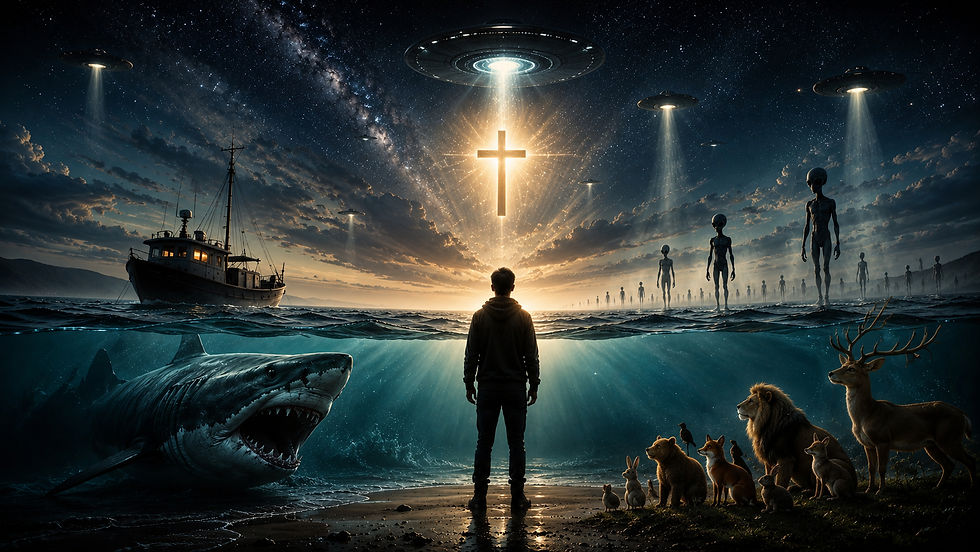
The Two Deeps
There are two deeps that have always frightened the sons and daughters of earth.
The one below, where the light fails, shadows move beneath the waterline, and fear waits just beyond the edge of sight.
And the one above, where the night sky hangs over woods and mountains, strewn with lights and shadows we see, but cannot name.
For fifty years, Steven Spielberg has worked the seam between them both. He began in the physical deep below us with Jaws, where shadows move beneath the waterline and fear performs its own dark baptism, immersing movie audiences in dread of what they cannot see. Now, in Disclosure Day, he turns our eyes upward to the cosmic deep above. But the movement is reversed. Instead of teaching us to dread what may rise from below, he asks us to welcome what may descend from above — to receive, with unguarded hope, whatever shadows emerge from behind the veil of the sky.
In the trailer for Disclosure Day, and again in the film itself, Spielberg poses the question the whole film is built around: if someone showed you, proved it to you — that we are not alone — would that frighten you?
On its face, it is a question about fear. But the deeper question is faith: what happens when the unseen becomes visible, when mystery arrives with a face, and when wonder begins to ask for trust? Will that destabilize your faith?
Which raises the question a careful viewer must ask: whose faith?
Spielberg does not stage this reckoning in a synagogue, temple, mosque, sangha, or in the tepid certainties of the unbeliever. He stages part of it in a Catholic monastery. The anxious believer is Jane, a former nun who left the convent, but not the question of God. Spielberg’s voice of wisdom is Sister Maura, a Catholic nun. The crisis turns on the words of Genesis. Of all the world’s ways of believing, he has chosen to test ours: Christian faith and the Catholic expression of it most specifically of all.
That is his right. A storyteller may set his story wherever he pleases. But in choosing to handle the Christian Scriptures, the Christian God, and the Catholic faithful, he steps onto ground that can be measured and he submits himself to the old tests of accuracy, truth, intention, and honesty.
To assist with such tests, we will turn to Francis Schaeffer, a twentieth-century evangelical theologian, philosopher, cultural critic, and founder of L’Abri Fellowship, best known for helping Christians think seriously about art, philosophy, culture, and worldview. In works such as Art and the Bible and How Should We Then Live?, Schaeffer argued that art should not be judged only by moral or religious content, but by a fourfold weighing of craftsmanship, honesty, worldview, and the fit between message and medium.
This essay means to apply both: the ancient moral tests and Schaeffer’s four standards.
But to weigh them fairly we must begin further back than the movie with this question: what is the essence of Art (a created thing) and does it carry the breath and life of its maker?
Francis Schaeffer’s Critical Grid
Schaeffer is helpful here because he refused the two easy mistakes Christians often make with art. He would not reduce a film to a tract, judging it only by whether its message is safe. But neither would he let beauty excuse falsehood. A work of art must be judged as art and as worldview, as craft and as witness.
In Art and the Bible, Schaeffer gives four standards by which a Christian may judge a work of
art. The first is technical excellence: how well the artist handles the medium itself. The second is validity: whether the artist is honest to himself and to his own worldview, or whether he is acting merely as a mercenary, making work for money, fashion, or acceptance.
The third is intellectual content: the worldview carried by the work, whether spoken openly or smuggled through sympathy, image, music, and plot. The fourth is the integration of content and vehicle: whether the artistic form actually harmonizes with the message the artist means to communicate.
This is exactly the kind of instrument Disclosure Day requires. A Christian viewer must be able to say, without fear, that Spielberg is a master artist. Likewise, he must also be able to ask, without apology, what that mastery is carrying into the soul of the viewer.
The Breath of the Maker
In the beginning...
In Genesis, God creates the heavens and the earth — the whole order of the universe — and
then forms mankind from the dust of the ground, breathing life into clay and making humanity in His own image. From that moment onward, humanity is earth and breath together: dust raised by the life of God, clay bearing His image, for we are all shades of clay. In Exodus, Bezalel is the first person Scripture explicitly describes as filled with the Spirit of God for wisdom, understanding, knowledge, craftsmanship, design, and sacred making — or, as some would call it, co-creating or co-making.
This is not incidental. The first person in Scripture explicitly described as filled with the Spirit of God is not first named as a king, prophet, warrior, or priest, but as an artist-craftsman,
commissioned to make the tabernacle beautiful and holy. Creation begins with the breath of
God. Sacred Making begins with the Spirit of God.
The history of Art keeps circling this mystery.
In the high Renaissance, Michelangelo holds that a figure — a statue — sleeps
within the marble; that the sculptor does not invent it but frees it, uncovering a form that
waited in heaven before it ever waited in stone. The hand that carves obeys the intellect that
sees what is already there. On the Sistine ceiling he gives the vision its image: God’s hand reaching across the void to Adam, the breath and spark of the Maker passing into the one He has made.
Leonardo da Vinci insists that painting is cosa mentale, a thing of the mind, born inwardly
before any line is drawn, the painter holding the forms of creation within him and bringing
them forth as a second maker beneath the first: God Himself.
The Victorian John Ruskin insists that a made thing carries the very life of its maker.
Dostoyevsky stakes the soul on the claim that beauty will save the world, for where there is
beauty, there must be an artist, a creator, and in the end — the Creator Himself above all beauty.
Tolstoy argues that Art exists to transmit one person’s inward feeling into the heart of another.
In the twentieth century, Dorothy L. Sayers finds in the maker’s mind the image of a creating
Trinity. Tolkien names the artist a sub-creator beneath the Maker. C. S. Lewis describes an
imagination baptized toward the good. Madeleine L’Engle saw true art as incarnational: not
propaganda in religious costume, but inward truth taking flesh in form, image, sound, and
story.
But a vessel — a created thing, a work of art — does not judge what it carries.
The witnesses throughout history listed above name the consecrated transmissions: the prayer, the baptized imagination, the Word seeking flesh, the image-bearer empowered to make works of art through the Maker of all things. Yet the same principle has a darker edge. If a made or created thing bears the breath of its maker, then it will bear whatever the maker breathes into it. Not every transmission is holy. Not every image heals. Not every act of artistic incarnation gives flesh to truth.
Some works carry wonder.
Some carry worship.
Some carry mercy.
And some carry fear.
When the Vessel Carries Fear
Steven Spielberg was, by his own account, a frightened child afraid of small spaces, of the tree outside his bedroom window, of storm clouds, darkness, and the world that changed shape after sundown. He did not find a way to dissolve those fears. He found a way to move them. He told terrifying stories to his younger sisters. The telling, he said, removed the fear from his soul and transferred it right into theirs.
That sentence is not speculation. It is confession. It is not a critic prying into the private
chambers of a maker’s heart. It is the maker naming his own method.
Fear, in Spielberg’s hands, was not merely expressed by Art. It was relocated through Art. The vessel did not purify what it held. It purged itself from it by passing it on to others. Jaws was that mechanism built to industrial scale.
Spielberg took the project, in part, as an act of imaginative retaliation: the novel had frightened him, and he wanted to strike back at what had frightened him. Then circumstance handed him his method. The mechanical shark kept failing, so the monster could rarely be shown. Terror had to be built instead from everything around the absence: the camera dropped to the waterline where the swimmer cannot see what the audience cannot see either; the deliberate refusal to let land enter the frame, so the viewer would feel the same closing isolation as the men on the boat — nowhere to swim, no shore to reach, no visible escape.
He made the unseen do the work the imagination always does best, which is to supply a horror more visceral, jarring, and emotionally imprinting than any fake shark could manage.
And then it was broadcast. Jaws became the highest-grossing film made to that point and the prototype of the summer blockbuster — which is to say the transmission reached nearly everyone. A boy’s private dread, sublimated into two hours of silver-screen light, was copied into millions of nervous systems worldwide and gripped in suspension there.
People who would never meet a great white shark acquired a fear of one. But the deeper mark was never merely the shark. Across fifty years, critics, viewers, and Spielberg’s own
collaborators have returned to the same recognition: Jaws did not leave a generation afraid only of a predator. It left them afraid of the water, of the unseen, the unknown, the shadow — or evil — that may be lurking just below the line of sight. In the water. On the land. In the sky. Anywhere.
The shark was the occasion. The true cargo was dread of what cannot be seen and cannot be
controlled.
That dread proved immune to every fact a marine biologist could marshal against it. You cannot reason a person out of a fear that bypassed reason, lodging itself into the infinite recesses of the mind and soul. Jaws did not invent the fear of the deep or of the unseen: it gave that fear a permanent image, a sound, a rhythm, and a conduit through which to enter the world.
I know, because I was infected by it.
I was a child of that generation, and the fear Spielberg breathed into the dark of the theater
lodged itself into me as I turned thirteen years old and would not leave. It was never only about a shark. It was the darkness itself — the shadow below my line of vision, the dreaded evil that might rise without warning from beneath my own awareness.
It held me for almost twenty years: fear of oceans, lakes, rivers, streams, creeks, pools,
darkness, shadows, nighttime, the woods, my home, my bedroom, and more. Anything that did not reveal what lay beneath became suspect. And I was not alone. Many viewers have testified to carrying similar illogical fears. It became, for many of us, a kind of cultural contagion: an image-borne fear that lodged beneath reason. Thankfully, I was eventually delivered from this, not by argument or reason, but by prayer, by God, by the slow and deliberate pursuit of being set free from a terror that had been breathed into me before I was old enough to refuse it.
That is the power of the vessel; the power of art. For good — or for ill.
What a maker pours into a work through spirit, intention, fear, longing, or conviction becomes part of the work’s inner life; and when the audience encounters it, that life can enter the imagination, the body, the memory, and the places beneath consent.
Which is precisely why it matters, gravely, what a maker chooses to breathe into a work the
whole world will encounter.
The Age of Disclosure
Fifty years on, the same maker returns to the same method.
Only the cargo has changed.
Disclosure Day is not merely another alien adventure. It arrives inside what journalists and
Unidentified Anomalous Phenomena (UAP) believers have called an Age of Disclosure — after the 2017 public reporting on the Pentagon’s UAP program and the 2023 congressional hearings that brought UAP testimony into the center of American public discourse.
Spielberg has said that these developments rekindled his interest and that, based on visual evidence and testimony, he has no doubt Earth has been visited by off-world species since Roswell. Whether or not that makes him part of a government soft-launch is not the focus of this essay. The public facts are already enough. Spielberg believes the question matters. Screenwriter David Koepp has said Spielberg viewed this film as the summation of what he had to say on perhaps the single most important subject to him.
So the film must be treated accordingly.
It is not simply spectacle. It is testimony.
And if it is testimony, then the question is not only whether it is beautiful or entertaining. The
question is: what does it testify to?
Spielberg’s Disclosure Day asks: what becomes of human faith if we learn, beyond all doubt, that we are not alone? It is a fair question to ask. Christian faith need not be threatened by the bare possibility of other creatures in God’s universe. If God is God at all, He is God of every star, every world, every creature, every intelligence, visible and invisible.
But a film does not merely ask. It answers — in image, music, structure, sympathy, and climax.
It answers in the mouths of the characters we are given to trust. It answers in what the camera reveres. And the answer it breathes into its audience is the thing to watch.
Before Judgment: Excellence and Validity
By Schaeffer’s first standard, technical excellence, Disclosure Day must be honored before it is opposed. Spielberg remains one of cinema’s great handlers of wonder, dread, motion, faces, light, and communal attention. Even reviewers who criticize the film’s ideas tend to acknowledge the charge of its set pieces, the fluency of its visual grammar, and the skill with which the camera converts spectacle into shared feeling.
The actors serve that excellence. Emily Blunt grounds Margaret Fairchild in finite human strain rather than superhero invulnerability. Josh O’Connor gives Daniel Kellner’s whistleblowing a moral unease rather than simple bravado. Colin Firth makes Noah Scanlon frightening not because he is monstrous, but because he is polished, managerial, and plausible. Colman Domingo gives Hugo Wakefield the calm authority of a secular prophet. The craft matters, because the craft is what makes the transmission believable.
By Schaeffer’s second standard, validity, the film also appears sincere. It does not feel like a
mercenary piece of franchise machinery. Spielberg’s public comments show that the question of UAPs and alien disclosure is not a borrowed trend for him. He has said he finds recent UAP disclosures compelling and long overdue, and that he has no doubt Earth has been visited by off-world species since Roswell. Screenwriter David Koepp has likewise described an unusually focused process, with Spielberg’s own treatment forming the bones of the story and many rounds of revision shaping the final work.
So the critique cannot honestly be that the film is careless, cheap, or cynical. Schaeffer would
forbid that shortcut. Although, if truth be told, a quick mention here is merited for at least four moments in the film that are eye-raising in their lack of credibility: when Daniel runs along a split-rail fence behind a hundred government agents — unseen; when Daniel and Jane hide behind a rock a few feet from several federal agents instead of fleeing the scene — and are unseen; the fake Disney-esque animals that lure the children into the woods; and the weird elderly alien at the close of the film that we are meant to adore and venerate. But the deeper danger is precisely that Disclosure Day is technically skillful and sincerely made. It is not a crude vessel. It is a beautiful one. Therefore the question becomes sharper, not softer: what does this beautiful and valid vessel carry?
The First Test: Accuracy
The hinge is a telephone call. Jane, a former nun who has not stopped circling the question of God, is unsettled by what the coming revelation will do to the world’s belief. Her concern is not merely social panic. It is idolatry. She fears that awe of alien intelligence will dethrone God in the human imagination — that “supreme beings” will replace the Supreme Being. Then comes Sister Maura, written as the film’s wise and gentle voice of faith. She answers with equanimity: Genesis describes what God made on earth. It does not rule out other worlds. Why would God make such a vast universe and save it only for us?
Taken at that level, the line is not heresy. It is even, in part, true. Genesis does not say that the whole cosmos is empty of all other embodied intelligence. The Christian and Jewish traditions have long been able to entertain questions of other worlds without requiring the collapse of faith.
But the first test is accuracy, and the trouble surfaces in the premise the film allows to stand.
The conversation turns on the spoken lines in a pivotal scene that Genesis calls humanity the supreme creation, or supreme beings, at least on earth. Scripture says something altogether different, and altogether greater. It says that God created mankind in His own image; male and female He created them; and into the dust He breathed His own life.
Our standing was never supremacy — not of intellect, not of power, not of rank in some cosmic ledger. It was the image of God, and the breath of God, in the dust.
The film quietly exchanges that category for another, and then bargains only over its scope:
supreme on earth, perhaps, but not across the universe.
Once the question has been framed as a contest of rank, the ground is already lost: the Bible is misquoted to millions and humans are mislabelled. These mistakes appear small, but it raises the question: if the foundational scriptures and truths the entire film hinges on are misquoted, leading the public toward a desired end, why did the A-list writer and director, who know the scriptures, misquote them? Is this simply a mistake? Or a purposeful presentation of misinformation?
That question deserves an honest answer.
The Second Test: Truth
Accuracy, though, is only the surface. The deeper test is truth — not whether a sentence can be defended in isolation, but where the whole work finally points the soul.
Here Schaeffer’s third standard enters: intellectual content, the worldview that comes through the work. Disclosure Day is not only anti-institutional. It is revelational. Truth is hidden by elites, sought by the wounded, mediated by chosen witnesses, confirmed by higher Visitors, and received by the world in awe. That structure is religious before it is political.
And here the film does not stop at the exchange. Its alien Visitors are spoken of as higher, wiser, nearer to God. A woman, witnessing their gifts, crosses herself and bows. The created is eased, scene by scene, toward the place of the Creator, and it is eased there not by a villain, but through the sympathetic, the devout, the wise, and the wounded.
That is the genius of it — and the danger of it.
No one is frightened into this belief.
They are reassured into it.
This is where several favorable Christian readings are useful, because they reveal exactly how
the film wants to be received. These reviewers are not fools. Many see what is good in the film: the Church is not mocked; doubt is not demonized; Sister Maura is not a caricature; faith is presented as spacious enough to encounter mystery. That is not nothing. It may even be one reason the film is so effective.
The strongest deception rarely arrives wearing the face of contempt. It arrives wearing the face of sympathy.
The film gives Christians just enough honor to earn their trust. Then it asks them to keep
following the camera past what the one orthodox sentence actually permits.
The Third Test: Intention
Which brings the gravest test: intention.
Here we must speak carefully, but not timidly. I am not claiming to know the final condition of Spielberg’s soul, nor every private motive he would name for himself. No human can see that far. But we can judge a work by what it places before the audience, what it asks the audience to trust, what it trains the soul to receive, and what its images invite us to venerate.
With JAWS, the intention to transmit fear is not speculation. Spielberg himself gave us the key: he learned as a child that telling a story could remove fear from his own soul and transfer it into another’s. He then became a master of exactly that exchange.
With Disclosure Day, the intention is not the same in emotional tone, but it is similar in
structure. Spielberg is again using cinema to transfer an inward reality into the audience: not
fear of the deep this time, but the pressing past the fear of other beings in the universe to faith in the Visitors from beyond, faith in disclosure, faith in the healing power of the alien revelation. This is not merely a plot. It is the film’s catechesis.
This, I believe, is what Disclosure Day is built to breathe into a global audience: a quiet re-ranking of creation, in which Visitors from elsewhere stand nearer to God than the image-
bearers He formed from dust and filled with His own breath.
It is a beautiful vessel.
What it carries is a lie.
And the lie is exactly the inversion of Genesis, where nearness to God was never a matter of
capability, intelligence, technology, luminosity, or rank. A more advanced creature, however
radiant, remains a creature still.
The Alien Savior Beneath the Worldview
Schaeffer’s wider cultural critique helps name the wound beneath the film. Modern man,
having crossed what Schaeffer called the line of despair, keeps looking for a source of meaning large enough to rescue him after he has cut himself loose from the God who is there. He may look to politics, psychology, technology, sexuality, revolution, or the cosmos. But the search remains religious even when it refuses religious language.
Disclosure Day is saturated with that despair. The world is near war. Institutions lie.
Corporations hoard truth. Lovers cannot hear one another. Citizens are shielded from reality by those who claim to protect them. Into that exhaustion comes the alien disclosure as revelation, medicine, and salvation.
This is why the film’s worldview is more than curiosity about life beyond earth. The question is not merely, “Could God have made other creatures?” Of course He could. The deeper question is, “What role does the film ask these creatures to play in the human imagination?” If they arrive as fellow creatures, the Christian has room to wonder. If they arrive as saviors, mediators, healers, prophets, and objects of reverence, then the film has crossed from wonder into replacement.
The Fourth Test: Honesty
One test remains: honesty.
To be fair to the work, and to the many faithful readers who have already risen to defend it:
Sister Maura’s one orthodox sentence is genuinely orthodox. If God is God at all, He is God of the whole universe and everything within it. Intelligent life on some other world would be His creatures, no more His rivals than we are. Catholic, Protestant, and Jewish critics have said precisely this, and they are right to say it.
Taken as a line of theology on a page, they are right.
But a film is not a page — and its argument is not carried by its most careful sentence.
Its argument is carried by its images, its music, its climax, by what the camera kneels before.
The favorable religious reading is not foolish. It is incomplete. It quotes Sister Maura and too
often stops there, skirting past the rest of what the film releases into the air: the Visitors treated as higher beings; the woman who crosses herself and bows; the human messengers endowed with powers that draw reverence from strangers; the final revelation staged as if salvation now descends from elsewhere.
The orthodox sentence is real. But it also functions as a permission slip — the reassurance that lets the audience lower its guard while the deeper current of the film carries it somewhere that sentence never authorized. A defense resting on one safe line, while averting its eyes from what the work actually venerates, is the very defense the film was built to earn. And a work that must be defended that way has not been honest with the people it set out to reassure.
The Gingerbread House
Beneath even this lies something the film’s beauty is built to keep us from seeing. Strip away the Spielbergian glow, the swelling score, the faces lifted in wonder, the immaculate light falling like benediction, and look plainly at what the story asks us to receive as a gift.
Two children are taken.
Lured.
Abducted.
To keep their minds from breaking, the Visitors come to them disguised — not as themselves, but as a Disney-esque cardinal, a deer, a raccoon, a fox, the gentle creatures of a child’s picture book — and lead them into a place the film itself names the Gingerbread House. There the children are altered: their minds rewired, their natures remade, one toward pure logic and the other toward pure receptivity and feeling. And the purpose is not simply the children’s good, but the Visitors’ design. The two are engineered, from boyhood and girlhood, to become the messengers through whom the whole earth will at last be brought to accept them. Are they being used as a Trojan Horse? We do not know. Or do we?
A Stranger puts on a friendly face to win a child’s trust, takes the child, changes the child, and returns the child as an instrument.
Scripture has a name for a Power that robes itself in light to deceive.
This is the mask that must be unveiled.
But the film has another name for it:
Benevolence.
This is why the film’s softness is not an answer to the critique. It is part of the critique. The
terror is not that the Visitors look monstrous. The terror is that they do not. They come as
wonder. They come as childhood animals. They come as healing. They come as light.
Possession by Another Name
Schaeffer’s fourth standard — the integration of content and vehicle — is where the film
becomes most spiritually disturbing. The script says benevolence. The cinematic vehicle often says: possession.
Margaret suddenly speaks languages she has not learned, makes alien sounds, knows what she should not be able to know, and is remade into a human receiver for a nonhuman message. Jane is violated by technology that enters her mind and alters her eye color. Daniel and Margaret are marked from childhood by beings who approach them through disguises, alter them, and return them to the world as instruments of disclosure.
A Christian critic need not declare that every alien image in the film is literally demonic in
order to notice the category confusion. The film uses images and actions that have long
belonged to the grammar of spiritual invasion: involuntary speech, psychic intrusion, loss of
ordinary agency, eyes changing color, hidden intelligences entering the mind, a body made into a mouthpiece, and then asks the audience to receive that invasion as gift.
That is not harmony between content and vehicle. It is dissonance. The message tells us to trust the Visitors. The vehicle teaches us to recognize violation. The film calls it evolution, empathy, disclosure, and benevolence. Again, the form keeps whispering another word: possession. The imagery only deepens the disturbance: a crucifix in Jane’s hand pierces her palm like a nail and draws blood; she is forced to drop it as an astral projected agent (using secret powers from the Visitors) enters the room spiritually, compelling her toward violence against Daniel before he can complete his mission to reveal the hidden footage to the world.
This may be the most honest part of the film, because it reveals the cost of seeking
transcendence apart from the Creator. When a human person becomes sacred chiefly because a higher creature can speak through her, the image of God has not been honored. It has been commandeered. Invaded. Possessed. Violated.
The Hollowed Apocalypse
Disclosure Day reaches, too, for the architecture of Christian apocalypse.
Here are Two Witnesses, marked from childhood, set apart, given powers not their own, who
will stand before the world and unveil the revelation that changes everything. That is the very
shape of Revelation’s Two Prophets, the Witnesses who herald the close of the Age -- and the beginning of the next.
But the film severs the image from the root that gave it life.
The testimony of the Two Witnesses in the book of Revelation is to Christ. The revelation they announce is His coming in judgment and glory.
Spielberg keeps the shape and hollows it: the marked messengers, the world-altering disclosure, the awe before a coming presence — and into the hollow pours not the Second Coming of Christ, but the revelatory coming of the Grays.
It is the oldest substitution there is: the form of revelation preserved, as its God is exchanged for a god or gods.
The Final Command
The ending makes the argument plain.
After the files are released and the world sees the Visitors, an alien message is decoded. Daniel whispers the message to Margaret. Then Spielberg’s camera comes in tight, so tight that Margaret seems to address not only the fictional world watching within the story, but the actual audience sitting in the dark.
She says one word.
Listen.
That is not a neutral ending. It is not merely ambiguity. It is a command.
And the command comes after the unveiling. The world has seen. The creature has appeared.
The message has been given. The human mediator now turns toward us, and the film’s final act is to make the audience receptive.
Listen.
But to whom?
To what?
To the God who breathed life into dust? Or to the new voice arriving from the sky through
two previously abducted children carried by beautiful images, protected by sympathetic believers, and framed as the revelation that may save humanity from itself?
That is the question the film leaves behind. And it is not a small one.
(Note: although it is portrayed in this film that there are only two children who were abducted for the special mission of being "gifted" by the aliens to one day be used as "passengers" to speak to the world on their behalf, the wider disclosure culture in our world reports countless victims of such traumatizing alien abductions. This essay is not meant to address the nature of those reported abductions, but it is another example of misinformation and misdirection that Spielberg sweeps under the metaphorical rug.)
A Personal Witness
Here I must turn personal again.
Watching Disclosure Day, I felt a physical nausea — not the turn of a bad meal, but the body’s answer to something my spirit had already discerned. Everything this essay has argued was, in that darkened room, made flesh. I could feel the maker’s breathed intention, the inward life poured into the vessel, animating the film from within like a pulse.
My spirit recoiled from what it sensed there — and my body followed it down.
The same unseen dread that Jaws pressed into me as a child, and that held me for twenty years, was here again — only now it was not hunting beneath the water. It was pulsing from the light of the screen, reaching toward me in the audience in the language of wonder. Yet there I sat, sickened in body and spirit.
Spielberg was doing what he has always known how to do: breathing an intended reality into
people who may not know what is entering their imagination, their psyche, their soul. Sometimes for good. Sometimes not.
But do people know the difference?
I do.
And knowing, I prayed and shut the door of my body, mind, and soul against what pressed at it, and I was kept. I will not give this one another twenty years. I watched with guardedness, shutting the door of my heart, because I have learned to do so in wisdom.
But what of the others in that dark room, the innocent, the unguarded, the naive, who came
only to be amazed? How many people know that we actually have an invisible door in our heart and mind to close or to open? Dare I say, for many people that door is wide open — receiving innumerable messages broadcast from a thousand sources every day, influencing choices they never know they are being influenced to make.
Cultivation Theory
This is what media scholars call cultivation: the slow shaping of what a people takes to be real and ordinary by the images it is shown again and again. A film the whole world watches does not merely depict the acceptance of the Visitors: it rehearses its audience in that acceptance, scene by scene, until the upturned face of worship comes to feel like the only natural response.
And it arrives at a curious hour.
The culture is already being catechized by disclosure language: government hearings,
testimony, leaked videos, official uncertainty, podcasts, documentaries, a Catholic priest recently removed from his role as an exorcist after publicly warning that some UFO phenomena may be demonic, and now one of the most beloved filmmakers in the world turning that expectation into sacramental spectacle.
Again, one need not claim conspiracy to ask the necessary question. The timing alone is enough to make a Christian critic watchful.
Why this story? Why now?
How can any maker — even one of the most gifted filmmakers who has ever lived — be so sure that whatever is not human must therefore be friendly and mean us only good?
How can a film so aware of human fear be so trusting of nonhuman light?
And how can a Christian viewer fail to remember that Scripture warns not only of darkness, but of false light?
The Creature and the Creator
Over the course of fifty years, Spielberg has repeatedly drawn our gaze toward the terrifying unknown and helped shape our relationship with the unseen. He began in the physical deep below us in Jaws, where shadows move beneath the waterline and fear performs its own dark baptism, immersing movie audiences in dread of what they cannot see. In Disclosure Day, he turns our eyes upward to the cosmic deep above. But now the movement is reversed. Instead of teaching us to dread what may rise from below, he asks us to welcome what may descend from above — to receive, with unguarded hope, whatever shadows emerge from behind the veil of the sky, and to treat them as benevolent saviors.
Yet when navigating such deeps, a reliable compass matters.
Genesis establishes the ground. Spielberg shifts the cultural ethos. Schaeffer provides the grid for discerning and deconstructing what we are seeing, feeling, and being asked to receive. Jaws proves the power of cinematic transmission: how skillfully a filmmaker can breathe fear into the imagination of the world. Disclosure Day reveals something even more spiritually profound — and far more dangerous. It shows what happens when fear of the unseen is not redeemed by truth, but redirected into wonder; when wonder becomes worship; when discernment gives way to surrender; when fallen creatures, however luminous in appearance, are allowed to stand where only the Creator belongs.
The shadows may indeed be unveiled in Disclosure Day. But the light this film offers is not necessarily dawn. It may be a counterfeit morning — bright enough to dazzle, beautiful enough to disarm, and dangerous enough to blind us to the One who actually hung the stars in the sky.
So may the Shadows be unveiled.
And may the Truth Himself be revealed.
Notes and Cross-References
These notes are included for revision and fact-checking.
Francis Schaeffer / Art and the Bible: technical excellence, validity, intellectual
content/worldview, and integration of content and vehicle used as the article’s added critique structure.
Lars Dahle and Southeastern Seminary summaries were used to cross-check Schaeffer’s four
standards and their application to media beyond painting.
Entertainment Weekly interview with Spielberg and cast: used to verify Spielberg’s stated belief in UAP disclosure and off-world visitation.
Backstage interview with David Koepp: used to verify the 42-draft discussion, Spielberg’s
treatment, and the unusually focused development process.
Men’s Health, GQ, and The Guardian spoiler discussions: used to cross-check Margaret, Daniel, Wardex, the final “Listen,” the woodland-creature/Gingerbread House material, and the mind-intrusion imagery.
National Catholic Reporter, Catholic Review, and The Gospel Coalition: used to cross-check
favorable Christian readings so the critique can treat them fairly before arguing that they are
incomplete.
SPIELBERG: SHADOWS UNVEILED
FEAR, DECEPTION, AND THE THEOLOGY OF THE UNSEEN -- FROM JAWS TO DISCLOSURE DAY
by Kevyn (Kevin) Bashore
Thesis: Disclosure Day is dangerous not because it imagines extraterrestrial life, but because it turns cinematic wonder into theological inversion, training the soul to trust the unseen without discernment and to welcome the creature where only the Creator belongs.
Synopsis: The central danger of Disclosure Day is not its belief in extraterrestrial life, but its theological inversion. Spielberg moves from teaching audiences to fear the unseen in Jaws to teaching them to trust the unseen in Disclosure Day — yet the film offers no reliable spiritual compass for discerning whether what descends from above is light, shadow, creature, savior, or deception. Through Genesis’s ground and Schaeffer’s grid, the film becomes a warning about cinematic wonder untethered from truth: how beauty can cultivate belief, reshape cultural norms, and train the soul to welcome the creature where only the Creator belongs.

Comments